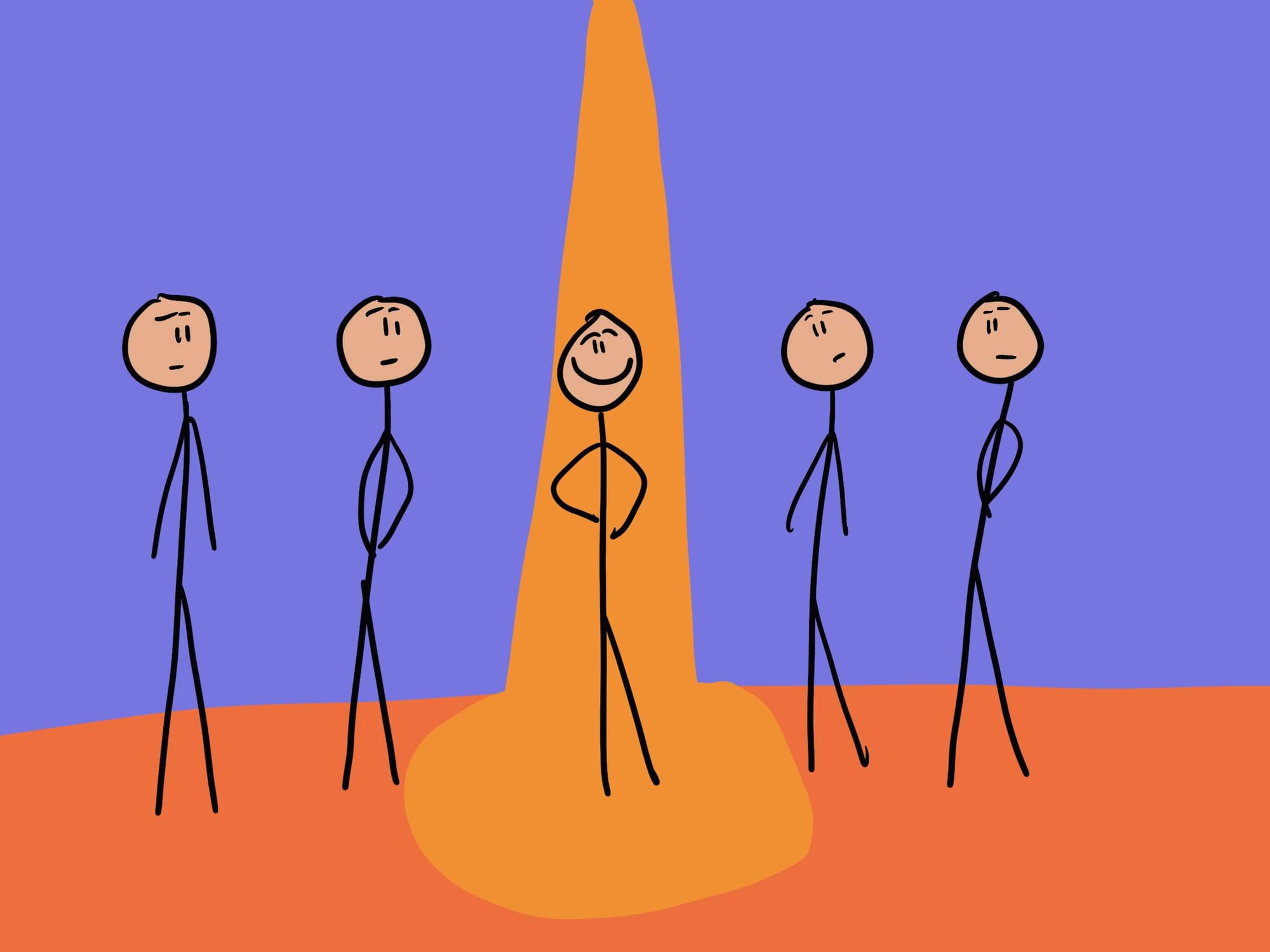
People tend to believe they are being noticed more than they really are.
The Spotlight Effect is a cognitive bias where individuals overestimate how much attention others are paying to them. People tend to believe that their actions, appearance, or mistakes are more noticeable to others than they are. This bias occurs because we are highly focused on ourselves, assuming that others are equally focused on us, even though this is rarely the case—in other words, our tendency to always feel like we are “in the spotlight.”
This bias shows up frequently in our day-to-day lives, both in positive situations (like when we nail a presentation and overestimate how impressed all our co-workers must be) and in negative ones (like when we bomb the presentation and feel like everybody must be laughing about it behind our backs).
Do you remember that one time in school when you tripped on something, fell on your butt, and everyone saw you? Of course, you do, and it may have been one of the most embarrassing moments of your life. But chances are, no one remembers but you. And those who remember probably don't think it was as bad as you thought.
https://www.youtube.com/watch?v=MRPtSy6i0BE
This bias is even more useful when we want users to perform some "public" actions (e.g., sharing a photo on the wall or making a public post).
If the target audience of our project is shy people, then understanding the spotlight effect will make us approach more carefully when communicating (via UI) with the user.
If our audience is people looking for attention to their person, then our approach can be more “confident”. So, we can afford more "personal" notifications ("You like %username%!!!"), dynamic and flashy visual effects.
We are likely to create a number of features of the system that will ignite the desire of our users to receive more attention.
Understanding the Spotlight Effect can help create more user-centered experiences by addressing user anxieties. For example, when users interact with a product or website, they may feel self-conscious about making mistakes or navigating a complex interface.
Simplifying processes and providing subtle, non-judgmental feedback can help users feel more comfortable. Designers should also account for users' fear of being judged, especially on social or public platforms, and create supportive and forgiving environments.
For instance, an onboarding tutorial that gently corrects mistakes or allows users to try again without embarrassment can reduce the anxiety caused by the Spotlight Effect.
Reduces user anxiety: Acknowledging that users might feel overly self-conscious helps designers create more supportive environments.
Simplifies user experience: Providing subtle feedback and reducing error visibility can help users feel more comfortable interacting with products.
Encourages exploration: By minimizing the fear of judgment, users are more likely to engage deeply with a product or interface.