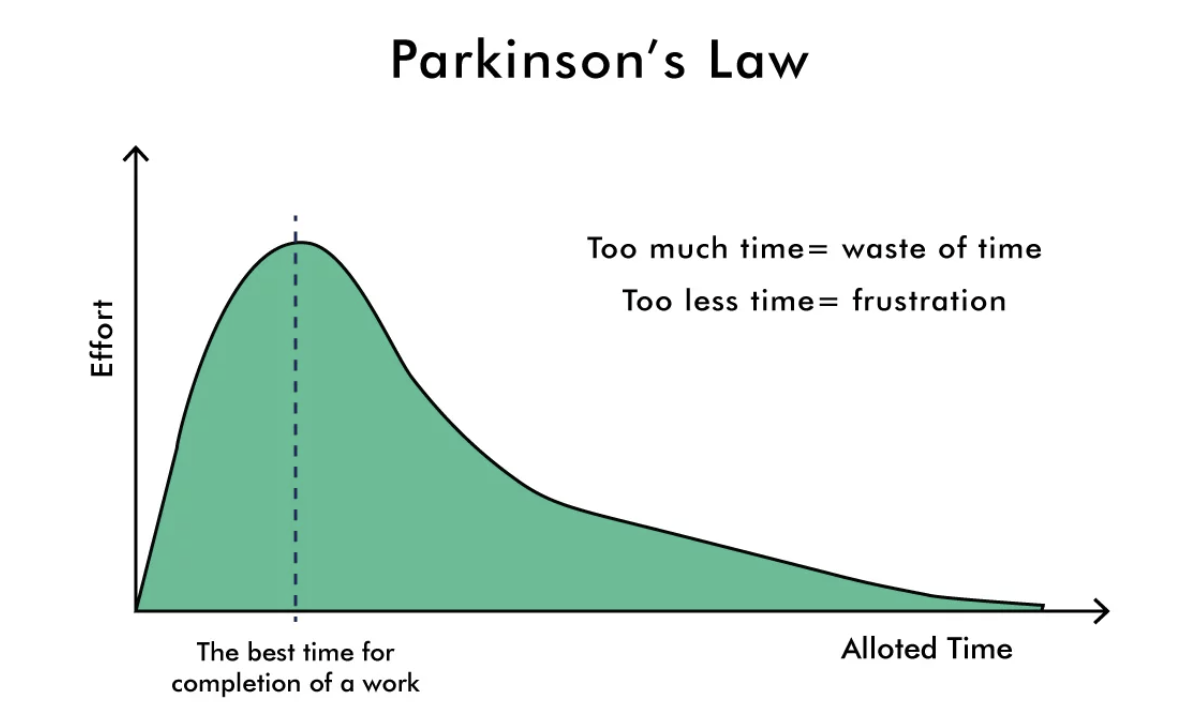
The time required to complete a task will take as much time as allowed.
Parkinson's Law, first articulated in 1955, states that "work expands so as to fill the time available for its completion."
This principle suggests that if you give yourself a week to complete a two-hour task, the task will grow in complexity and perceived importance to fill the entire week. The psychological mechanism behind this law involves human tendencies toward procrastination, perfectionism, and the subconscious adaptation to available timeframes. When given abundant time, people tend to overthink, add unnecessary complexity, or delay starting the task until pressure builds.
The law operates through two main mechanisms: First, there's the psychological pressure that creates focus and efficiency when deadlines are tight, and second, there's the natural tendency to complicate simple tasks when given excess time. This phenomenon isn't just about procrastination; it's about how we unconsciously adjust our work patterns to fill available time slots.
https://www.youtube.com/watch?v=tlddeUri3GM
In design contexts, Parkinson's Law manifests in several critical ways. When designers are given open-ended or overly generous timeframes, they often fall into the trap of over-designing, adding unnecessary elements, or becoming paralyzed by endless iterations. This can lead to feature creep, where simple designs become unnecessarily complex, or analysis paralysis, where designers spend excessive time contemplating minor details.
The law particularly impacts the creative process in UI/UX design, where the abundance of time can lead to overthinking user flows, adding superfluous features, or endlessly tweaking visual elements without meaningful improvements to the user experience. Understanding this principle helps design teams set more effective timelines and maintain focus on essential design elements.
Apple's Design Sprints: Apple is known for implementing strict time constraints on design iterations. Their design teams often work with tight deadlines to maintain focus and prevent over-complication of product designs, resulting in their characteristically simple and elegant solutions.
Google's Material Design: The development of Material Design guidelines was initially constrained by specific timeframes, forcing teams to focus on core principles rather than endless possibilities. This resulted in a cohesive and implementable design system rather than an ever-expanding set of guidelines.
Spotify's Design Process: Spotify uses time-boxed design sprints where designers must complete specific tasks within strict timeframes. This approach has helped them maintain rapid innovation while preventing feature bloat in their interface design.