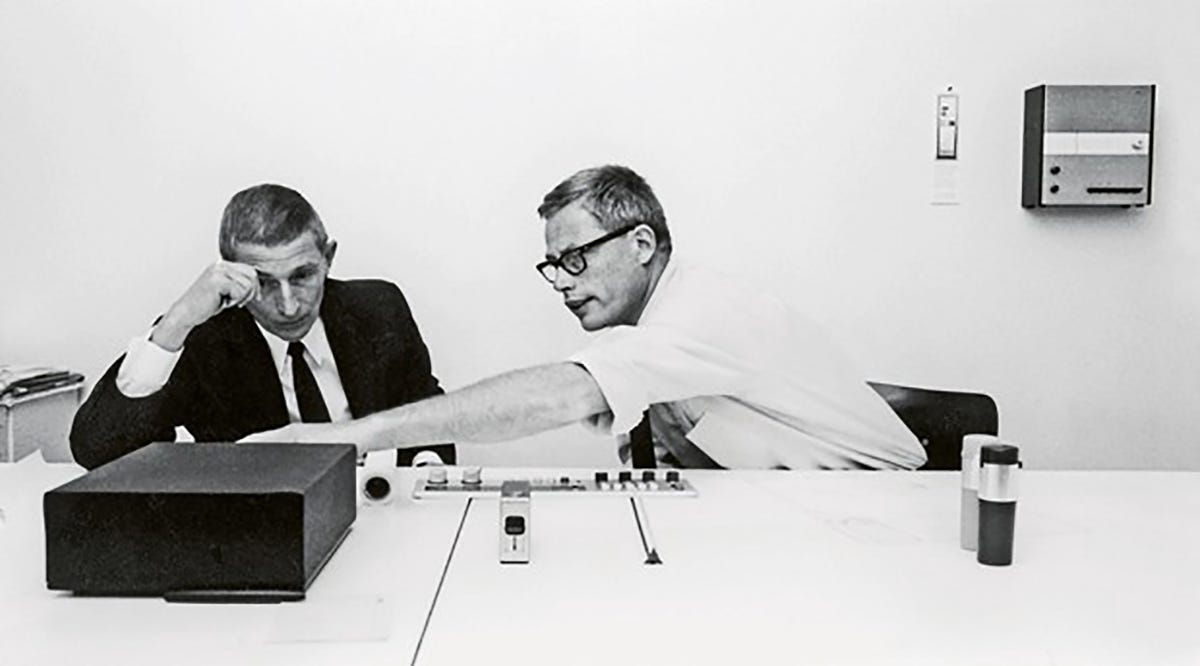
Prompted by an eagle-eyed friend, Rams applied for a job at the German electrical products company, Braun, in 1955. He was recruited by Erwin and Artur Braun following the death of their father and his job was to modernize the interiors of the company that was launching revolutionary electrical products.
Rams became a protégé of the Ulm School of Design (successor to the Bauhaus) luminaries Hans Gugelot, Fritz Eichler and Otl Aicher.
He quickly became involved in Product Design — famously adding the clear perspex lid to the SK4 radiogram in 1956 — and was appointed head of design at Braun from 1961 to 1995.
The objects were reduced to the essential and stripped of any distracting elements in order to simplify the product. “The aesthetic clarity of Braun’s products is the result of the logical ordering of the elements and the search for a simple and harmonious totality.”
Rams has radically changed the way we perceive electronic objects, with his experience and his modular way driven by clean and uncluttered lines. He implemented a new aesthetic style that would serve as inspiration for future generations. His designs have as their main objective to improve people’s quality of life, by creating extremely functional, durable, and useful products that convey emotions that consumers identify with.
Together with his design team, he was responsible for many of the seminal domestic electrical products — and some furniture — of the 20th century.
As good design cannot be measured in a finite way, he set about expressing the 10 most important principles for what he considered good design.